Character Creation

According to the Oxford dictionary, the definition of “story” is:

NOUN (plural stories)

Notice how the first element in this definition is “people.” That is, characters. Whether real or imaginary, all stories begin with a character. And only then can we as writers put them into messes and conflicts and see what happens.
Sounds like bad news for those of us who come up with plotlines first. For instance, I can’t think of one idea where I came up with a character and said, “Now, what happens to this person?” Rather, it goes something like this: “I”ve got a slew of dead bodies piling up in Jack the Ripper-esque fashion, and now I need someone to stop the killer before he strikes again.”
And guess what? I can’t go any further without figuring out who that person is. I can’t even really go any further unless I know why this killer is doing what he’s doing. So see, it’s not that hard to start with character even if you’re a plot fiend like me. Because whatever inspires you to write a story, you’re still going to need a character. That’s why the first step in Karen S. Wiesner’s First Draft in 30 Days begins with character creation.
Now while I won’t share any of her brilliant insight or worksheets (you’ll have to buy the book yourself), I will share my process of character creation using methods she describes tweaked by me. And that’s what you should be doing: take the knowledge you’ve learned from various sources and manipulate it until you find out what works best for you.
Any book on writing or writing teacher will probably have/give a list of character sketches to complete with categories like Physical Description, Background Information, Personality Traits, Internal Conflicts, External Goals, etc. But to really get to the heart of your character, it’s imperative to know what s/he would do in extraordinary circumstances. This, in turn, will organically inform other areas of the sketch you hadn’t previously realized.
Here are some probing questions you might ask of your character (which may or may not make it into your story):
  1. What is your character’s biggest weakness/greatest fault?
  2. What is your character most afraid of?
  3. What is your character’s most prized possession? What one item or person would your character save in a fire and why?
  4. What is your character’s proudest accomplishment?
  5. What is your character’s guilty pleasure? Bad habits? Secret talent? Pet peeves?
  6. Who is your character’s greatest hero and why?
  7. If your character could bring anyone back from the dead, who would it be and why?
  8. What is one thing your character doesn’t know about him/herself? Who knows about this?
  9. Does your character have a recurring dream or nightmare and what is it? What wakes your character up at night?
  10. What is your character’s moment of most profound guilt? Redemptive forgiveness? 

But don’t stop here. Come up with your own questions. Anything that leads to deeper insight goes.

While some writers like (or need) to keep to a strict schedule, I’ve found it’s best to let things percolate. Fill out a few sections of the sketch at your leisure in any order you wish and revisit it often. There is nothing linear about writing and just because you don’t have an answer for one category in your sketch right now doesn’t mean you won’t in a few hours, days, or weeks. And it doesn’t mean you have to keep the first ideas you come up with either. As other elements of your story become clear, new ideas and answers will unfold. I promise.

In my last post, I mentioned how I didn’t like my main character. More often than not, my protagonists are neurotic, moody, overly-dramatic, bitches with a chip on their shoulders. I always love my secondary characters; they seem so much more complex, interesting, and sympathetic. Why is this? Maybe it’s because I have been writing in first person, and the only way I can show secondary characters is through action and dialogue–two of my strengths. I don’t have to get into their heads and describe what they’re thinking and feeling especially when there isn’t anyone else around to talk to.

What changed this time? I took out the horrible event from her past. Of course, I still needed a reason for my character to give up her education in the US to move to England, but it didn’t have to be so tragic. So now she didn’t have anything to prove or have a chip on her shoulder. She didn’t have to be tough (although she is). And that changed everything about her.

I wrote a few opening lines in third person to further remove myself:

Tate stepped off the plane all boots and leather and bleary eyes.

Then I made her outgoing, a chatty-cathy if you will, because, after all, if she’s going to be a journalist, she should probably like talking to people. So I wrote a few lines of dialogue between her and the cab driver:

 “The Queen said that?”

            “I swear on me mum’s grave.” Bartleby, the cab driver, crossed his heart and looked back at me in the rearview mirror. “Heard it straight from Georgie, me second cousin twice-removed.”

            “Georgie? The dishwasher with the lisp and the cauliflower ear?” I asked, leaning farther into the front seat.

            “Well, I only got one cousin who’s a dishwasher.” He erupted into a gurgling chortle that ended in a pneumatic wheeze.

            Wiping tears on the sleeve of my jacket, I gasped for breath between fits of laughter. “Wow. I never would have guessed.”

This new reincarnation of my main character percolated for at least a couple of months. I kept wanting to go back to some horrible event in her past. And I did. A couple of times. Until I finally settled on a more realistic reason for her to leave her friends and family behind, a reason that would connect her to the antagonist as well.

With this new inspiration, I was ready to work on all my characters.

First, I typed up a brief synopsis of each character’s identity and role in the story then filled out a pre-fab character sketch for each. For some characters, like my protagonist, I was able to fill out most sections relatively quickly. For others, like some of the secondary characters, particulary the red herring, I’ve only just begun to make a dent.

L: brief synopsis R: basic character sketch
L: brief synopsis
R: basic character sketch

Though you can’t quite see on the left image, there are some characters who only have one or two sentences descriptions as well as changes made to others after the fact. As a rule, I like to do most of my prewriting by hand. It seems more organic to me to have the thoughts flow from my brain to my hand to my pen to create the letters and words on the page. Typing is faster and less messy, and it’s all up to you how you like to write, but writing, in general, is messy. Plus, it’s easier to carry pieces of paper around with you to fill out as the ideas come instead of trying to get into a computer file. And, I’ve found, these sketches are not set in stone. I keep revising them all the time.

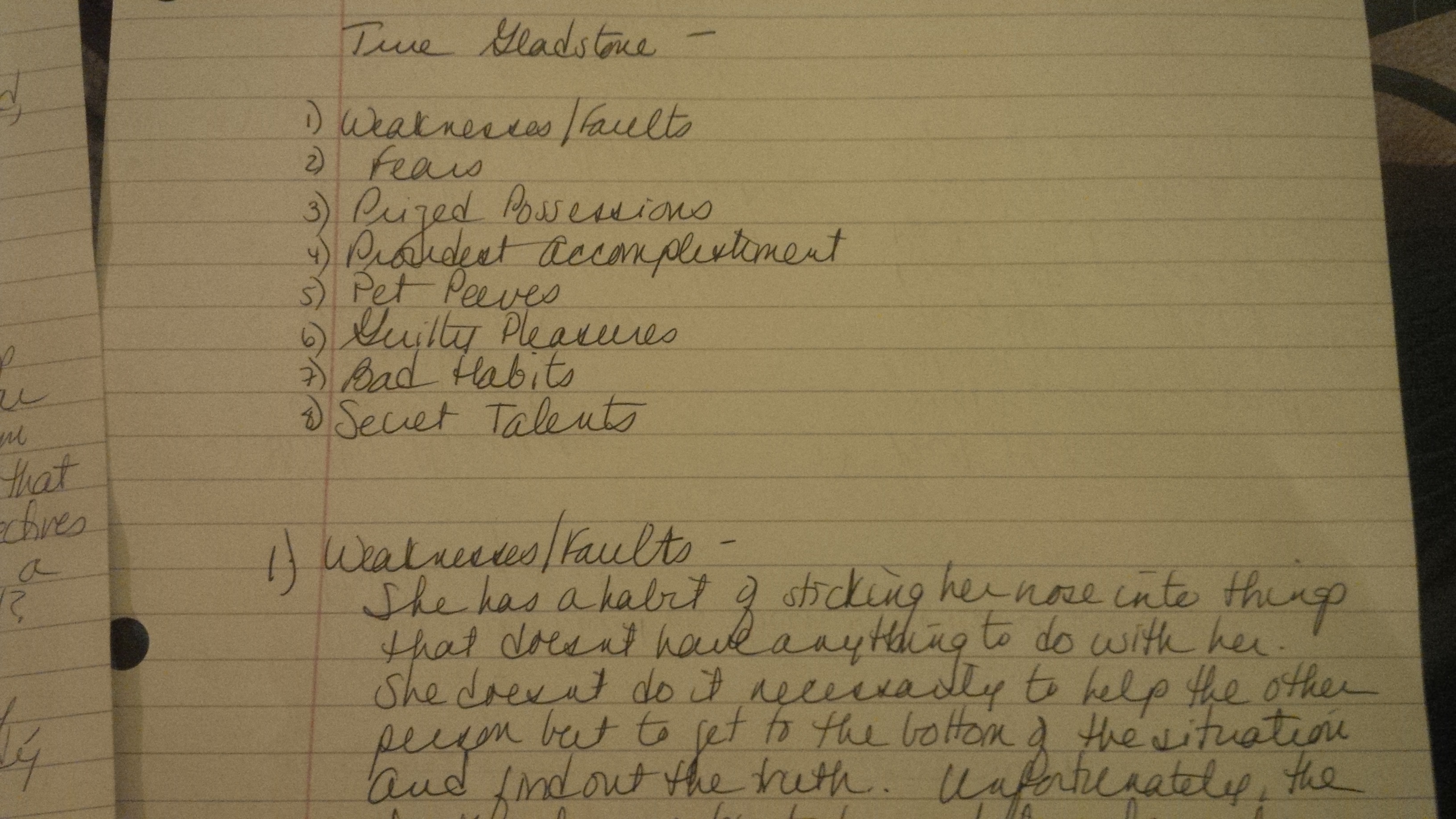
After I filled out the basic sketch, I worked on answering some of the harder questions for my protagonist and then free-wrote a summary of her backstory.
The hard stuff
The hard stuff
L: Antagonist freewrite R: Protagonist backstory
L: Antagonist freewrite
R: Protagonist backstory

The whole idea with freewriting is to just slap a whole bunch of ideas onto the page and see what sticks. I won’t use everything or maybe even anything that are on these pages, but getting your ideas out there on the page will lead to new and improved ideas you may never have come up with if you hadn’t gone through this process. I ask questions in my writing, some I follow up on, some I discard before even considering the answer. I make notations about things I would need to research. I contradict myself over and over again. And that’s okay. Nothing is perfect in this stage and it shouldn’t be.

There are other tricks writers use to get to know their characters, and I’ve tried pretty much all of them: journaling in your character’s voice, interviewing, writing dialogue between two characters, writing the scene of one of those hard questions. And you probably have some of your own methods: making a collage of your character’s favorite things, finding a photo of someone who represents your character, making a playlist that represents specific moments in your character’s life…

Whatever your strategies are, use them. Not just for your main character but for all your characters. Figuring out what motivates everyone will inspire new ideas. I promise.

If you’ve got a favorite method for creating characters or have a question or even just want to chat writing, leave a comment below. I’d love to hear from you.


To Pants or Not to Pants: The Age-Old Question

After two + years of post-grad education, a year of working 12 hour days, Christmas holidays, and shoulder surgery, I’ve decided to work on the 10th reincarnation of my MFA thesis.

I’ve always prided myself in being a pantser. Characters grew organically on the page and forged their own conflicts and resolutions. And while that’s great, more often than not, those stories were a million miles away from my original visions. I read recently in Damon Knight’s Creating Short Fiction: The Classic Guide to Writing Short Fiction, that there are four stages of writing:

creating short fiction

  1. The daydream stage when you are basically writing for yourself.
  2. The trivial stage when you are trying to break free from your fantasy shell but you haven’t quite cracked it yet.
  3. The technical stage when your stories are reasonable but lack structure or character.
  4. The professional stage when you have finally arrived as a writer.

Looking back, I think, in a way, that pantsing my past novels had actually hindered my goal of reaching stage four. I, as the author, was not in control of what I was writing. I relied on my characters to tell me where they wanted to go and what they wanted to do, and I know every writer longs for having this type of automatic writing experience, but it doesn’t allow the writer to tell the story only he or she can.

In fact, every time I tried to go back and rewrite or revise my finished novel, I couldn’t do anything with it because I didn’t like the main character or the story line. What else is there, you ask? I loved my setting and I loved my original idea of having a modern-day-Jack-the-Ripper-type murder mystery set on the English moors. Unfortunately, my novel didn’t even have a murder; it only had a disappearance, and it had more to do with The Phantom of the Opera than Jack the Ripper.

So after years of frustration, I decided just to rewrite the whole damn thing. And when I say “rewrite,” I mean start from absolute scratch. New characters, new plot, new everything. It took me years of not reading my original novel to be able to get it out of my head long enough for me to come up with new ideas that had nothing to do with the old ones. It’s a really hard decision to trash an entire 300+ page novel that took two years to write and two years to shop around to publishers and agents, but I wasn’t happy with it on any level. Because some (read “most”) of the story had autobiographical overtones, it was necessary to get that story out in writing, put it behind me, and start from a place unencumbered by personal emotion.

My decision to go from pantser to plotter came about after reading First Draft in 30 Days by Karen S. Wiesner.

first draft

It’d been sitting in my writing book cabinet for I-don’t-know-how-long. I don’t even remember when I bought it. But I noticed it, started reading it, and thought, hey, if I can make an outline so detailed it could pass as a first draft, then I was willing to take up the challenge. Though I haven’t kept the same schedule Wiesner recommends, I have learned that my characters and my plot can grow organically through the outline process while still holding true to my original vision. Organic growth doesn’t just have to happen during the writing phase. And while some people may consider outlining a pre-writing strategy, it is just as valid and, I am convinced now, even more necessary than what we have come to call the drafting phase.

For the next several posts, I plan to write about my process of going through Wiesner’s system, using my own variations of her techniques, complete with images of my writing. I do this so that, if you too are at a crossroads in your writing, you can make the transition from pantser to plotter without the fear and shame that you are cashing in organic storytelling for prefabricated stories.

That Was Then. This Is Now.

December’s a pretty busy time of year what with all the Christmas shopping, Christmas parties, Christmas itself (which realistically only lasts two hours), my sister’s birthday, school projects, the ballet, two plays, etc, so my friend and I decided it would be a good time to write a novel. Yes, we ripped off Chris Baty‘s November NaNoWriMo event and moved it to December because we were too lame (and late) to do it last month. 50,000 words, plus we get an extra day to do it in.

Oh, we also decided it would be well worth the effort to eat healthy and exercise every day while we were at it.

It’s the end of week one and I am totally impressed with ourselves. We both made our weekly quota of over 11k words. This is more words than I have probably written in the past ten years. They are not great words; it is not even a great story. In fact, I didn’t even have a clue what I was going to write about up until I sat down at my laptop on December 1 and had to write something.

My story is not going anywhere in the sense that I will never revise it or even consider doing anything more with it. At first, my Inner Critic was appalled.

IC: “What’s the point of spending all this time and energy and getting so stressed out to just write a piece of crap?” inner-critic

ME: “Well, Inner Critic, that is the point. Thanks to you, I have reread, rewritten, and reviled everything I have ever written to death, and it hasn’t gotten me anywhere. Why can’t I take this time to write something you have no control over and have fun with it? You know, fun, the way writing used to be before you showed up? And by the way, who the hell let you out of the kennel?”

So now my Inner Critic just sits on my shoulder and sniggers about the drivel dripping from my fingers as if he’s saying, “One day you’ll come back to me.”

That was then. This is now.

My friend and I posed the same challenge to ourselves in July. 50,000 words in 31 days. This time we failed. Neither of us even started past an idea in our head. We did manage to work on a graphic novel at least. But I felt kind of guilty that I wasted a whole month and never reached my goal even though I had already written three short stories. So I told myself that I would definitely write a novel in August.

Okay, it’s August 14, and I officially hate my Inner Critic. I’m seriously thinking about firing him because he’s a pain in the ass. When I was a  kid I wrote for fun, for me, for escape. I was the main character in all my stories and I led some pretty cool lives; I lived with rock stars, I dated rock stars, I was a rock star. I didn’t care about “character” or “plot” or “pacing” or “setting.” I just wrote and I’m pretty sure I hit all those elements without even trying.

Rock-Star

Then I got this brilliant idea: let’s go to school to study creative writing! And guess what? That’s when my stupid Inner Critic showed up! Now everything I write has to “measure up” to some invisible audience’s expectations. Or worse: a publisher’s. Consequently, education sucked the spontaneity, creativity, and innocence out of writing for me.

There’s been one project that I’ve been working on for awhile that I’m pretty proud of. It’s a fan-fiction serial based on World of Warcraft that I write in installments. I don’t write it for anyone but me and a few guildmates who may or may not even read it. I don’t plan on doing anything serious with it (like trying to get it published), so it’s actually fun and probably some of my best off-the-cuff writing.

That’s what I want to get back to with everything I write–that non-feeling of dread when I sit down at the keyboard (if I even get there). I don’t want to do character sketches, or plot summaries, or scene outlines. I just want to write with the same non-pressure feeling I used to when I could be anything I wanted. (Which was always apparently a rock star.)


Calling All You Writing Freaks


Halloween is by far the scariest time of the year. Not just because it is the one night when the veil between the worlds is opened allowing spirits, ghosts, and succubi to cross over into our realm or because gangs of teenagers run amuck through the streets toilet papering trees, waxing windows, and smashing pumpkins. Halloween is scary because it falls on the eve of NaNoWriMo. Yes, that dreaded month when every writer willingly surrenders himself into the depths of hell and participates in self-flagellation in the name of writing a 50,000 word novel in 30 days.

So I thought Halloween would be a great time to prepare yourself for the month to come. All you have to do is write for one hour at some point on October 31. It doesn’t matter what you write because the best part about this is that your writing can put on a costume and pretend to be whatever it wants for those 60 minutes. If it turns out to be just a character sketch, or backstory, or even a few lines of dialog, it’s okay! It’s come as you aren’t night. So don’t get all self-critical or go all hyper-editor on yourself. Just have fun! Because the next 30 days are going to be anything but.

In case you need a few suggestions to get you started, here they are: (and they’re all conveniently Halloween related)

1. Find an eerie image or a piece of haunting music to inspire you 

2. Write about what monster scared you the most as a child (or as a grown adult): vampire, Frankenstein, mummies, zombies, mad scientists, ghosts, witches, etc.

3. Write about what the town children would do if Halloween was canceled because of a freak weather anomaly

4. Pick your favorite Halloween costume from childhood. What was it? Why? Now write about what kind of life you as that “person” would have lived.

5. You’re getting your fortune told at a fair when the psychic tactfully informs you that you are already dead.

6. You foolishly accept a dare to spend the night in a cemetery/haunted house/abandoned prison/insane asylum/whatever.

7. You arrive at your friend’s Halloween party when one of the guests turns up dead.


Come on guys, it’s just one hour. Let go of your old habits and have fun with this. You never know where your next great idea will come from.

Enter this Halloween challenge…if you dare! Muwahahahaha.

Priorities, people!

I am a deadline fiend. Give me a date and a time when I need to have something done by, and I will do whatever it takes–stay up late, skip school, call out of work, etc.

In grad school, I thrived on deadlines. As part of a low-residency program, the creative writing degree required four submissions per semester via email to our mentors. Each submission consisted of two craft annotations, revisions from the previous month’s work, 30 pages of new material, and a cover letter detailing our experience. On top of that, we had to read between four-to-six books per month directly related to the genre we were working in or on the craft of writing books.

For the first two weeks of the month, I worked full-time, read all my books, and wrote my two papers. For the last two weeks, I took Fridays off from work and spent the entire weekends writing. On Fridays I would write from about 10:00 AM until 2:00 AM. Saturdays were the same except I would break from about 9:00 PM to 12:00 or 1:00 AM to play video games with my friend then back to writing until I fell asleep. Sundays I wrote from about 10:00 AM (or whenever I woke up) until 9:00 PM. I tried to write about one and a half chapters or roughly 15 pages per weekend. I got less done on Fridays because I always reread my manuscript from the beginning to get into the character, mood, feel, voice, etc.

The reason I excelled at this type of deadline was not just because I was getting something out of it (a terminal degree) but I didn’t want to let my mentors down either.

I have since tried to make my own deadlines to finish this novel or that screenplay, but I have never been able to enforce them or meet them. I blame it on my lack of priorities. I can sit at the computer and level my World of Warcraft toon until I use up all my rested XP or I hit the next level, but I can’t just sit at my computer and finish what I say I’m going to by my deadline. I guess I’m just not tough enough on myself.

Recently, it’s come to my attention that I am missing two opportunities to send my manuscript out to different publishers during their open submissions this month and missing an opportunity to enter a screenwriting contest with one of the prizes being a reading with Robert McKee. And it’s all because I failed to meet those self-imposed deadlines over the past few years. Oh, I get stuff done; it just takes forever.

Well you know what? I don’t have forever. I don’t want to miss anymore of those open submission calls. I’m sick of being a loser. I want a backlog of  manuscripts/screenplays ready to send out a moment’s notice. I mean, really, is this so hard?

(And don’t even get me started trying to complete NaNoWriMo or ScriptFrenzy. They happen in the two busiest months for me school-wise.)

I’ve decided what I need is to not call it a deadline. Because seriously, no one’s going to fail me if I don’t finish by a certain date. My “goal” is to finish revising/rewriting a specific manuscript by the end of the year (where have I heard that one before?).  And the reason why I think it might be doable this time is because I have a list of priorities.

The story needs some help not only with plot but with character. I also want to change from first-person, present tense narration to third-person, past tense narration. That will require one set of revisions. At the same time I’m going to focus on sentence variety (simple, compound, complex, compound-complex) and beginning sentences with more than just a noun, pronoun, or article.

Secondly, I’m going to do a major rewrite because my protagonist seems to have come down with multiple personality disorder. (I blame the photo I found for inspiration). I’m hoping this will lead the story to a plot more in line with my original vision.

And lastly, I’m going to tackle the first chapter. I’ve never really liked it and I think it’s because I’m not happy with the protagonist, so hopefully that by starting my revisions/rewrites after it, I won’t get frustrated and give up before page 10.